How to Calculate Shipping Costs for Your Online Store in Malaysia: Volumetric Weight, Zones and COD Fees (2026)
A step-by-step guide for Malaysian online sellers: the five parts of a shipping cost, how to work out chargeable and volumetric weight, zones and SST, COD fees, a return allowance, how to set customer shipping fees and seven ways to cut your courier bill.
- Published
- Reading time
- 11 min read
- Language
- English

On this page 12 sections
- The 5 parts of a shipping cost
- Step 1: Find the chargeable weight
- Step 2: Match the weight band and the zone
- Step 3: Add SST if it isn’t included
- Step 4: Add the COD fee
- Step 5: Allow for returns
- Putting it together: a full worked example
- How to set the shipping fee you charge customers
- 7 ways to lower your shipping costs
- Track real shipping cost per order in your order system
- Frequently asked questions
- Know your real shipping cost before you set your prices
Most online sellers know their courier’s price for a 1 kg parcel. Far fewer know what shipping really costs them per order. The rate card is only the starting point: a light product in a big box gets billed on its size, East Malaysia costs more than the Peninsula, COD adds a fee on every parcel, and every returned parcel costs you twice. When these add up quietly, a product that looks profitable on paper can lose money once it ships.
This guide shows you how to calculate shipping cost for each order in Malaysia, step by step: actual versus volumetric weight, weight bands and zones, SST, COD fees and returns. It also covers how to set the shipping fee you charge customers and practical ways to bring your courier bill down.
The 5 parts of a shipping cost
Before you calculate anything, it helps to know what goes into the number. Every courier structures its rate card a little differently, but almost every parcel cost is built from the same parts.
| Cost part | What it depends on | What to check on your rate card |
|---|---|---|
| Postage | Chargeable weight and weight band | Band sizes (for example 0 to 1 kg, 1 to 3 kg) and how weight is rounded |
| Zone | Where the parcel is going | Separate rates for Peninsular Malaysia and Sabah, Sarawak and Labuan |
| SST | Whether prices include tax | Whether the quoted postage is before or after SST |
| COD fee | Payment method and order value | Flat fee, percentage of the amount collected, or a minimum fee |
| Returns | Failed deliveries and rejected parcels | Return fee per parcel, and whether outbound postage is refunded |
Some couriers also add surcharges, such as a fuel surcharge or a fee for remote or hard-to-reach areas. If yours does, add it as a sixth line in your calculation.
Step 1: Find the chargeable weight
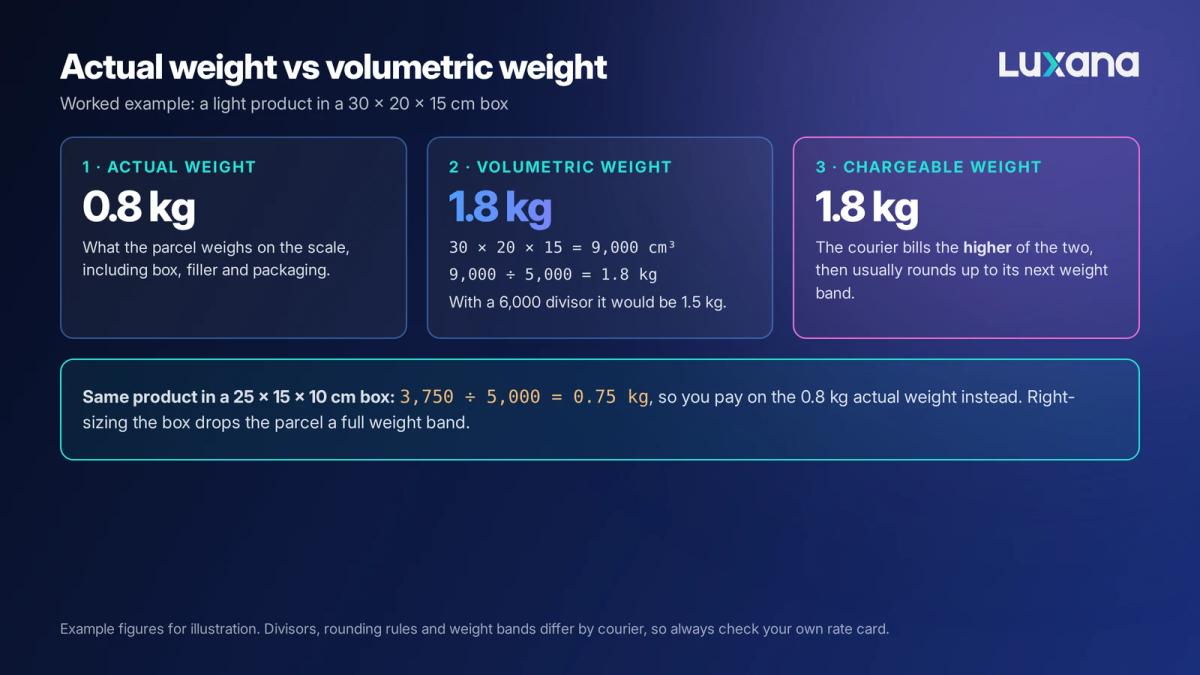
Couriers charge by whichever is higher: the parcel’s actual weight on the scale, or its volumetric weight, which reflects how much space the parcel takes up in the van. This matters most for light but bulky products like skincare sets in gift boxes, clothing, pillows or anything packed with lots of bubble wrap.
How to calculate volumetric weight
- Measure the packed parcel's length, width and height in centimetres, including the box and any bulge.
- Multiply the three numbers to get the volume in cubic centimetres.
- Divide by your courier's divisor. Many use 5,000; some use 6,000. Check your rate card.
- Compare the result with the actual weight. The higher number is your chargeable weight.
- Round up the way your courier does, usually to the next 0.5 kg or 1 kg or to the next weight band.
Step 2: Match the weight band and the zone
Once you have the chargeable weight, find the matching weight band and destination zone on your courier’s rate card. In Malaysia, most couriers price Peninsular Malaysia and East Malaysia (Sabah, Sarawak and Labuan) separately, and the East Malaysia rate is usually noticeably higher for the same weight.
The table below is an example of how a rate card is laid out. The figures are for illustration only and are not any courier’s actual prices.
| Chargeable weight | Peninsular Malaysia (example) | Sabah, Sarawak, Labuan (example) |
|---|---|---|
| 0 to 1 kg | RM 5.50 | RM 9.50 |
| 1.01 to 2 kg | RM 7.00 | RM 14.00 |
| 2.01 to 3 kg | RM 8.50 | RM 18.50 |
Two things to check here. First, whether bands are fixed (one price for anything up to 3 kg) or charge a first-kilo price plus a price for each additional kilo. Second, whether the same courier has different rates for different pickup points or account types. If you use more than one courier, build a small table like this for each one so you can compare them for the same parcel.
Step 3: Add SST if it isn’t included
Courier rate cards don’t always show prices the same way. Some quote postage with SST already included; others quote a price before tax and add SST on the invoice. Check which one your courier uses and keep it consistent, otherwise your cost per order will look lower than your actual monthly invoice. If your rate card is before tax, apply the SST rate shown on your courier invoice to the postage.
Step 4: Add the COD fee
Cash on delivery is still popular in Malaysia, but the courier charges for collecting the money and passing it back to you. COD fees usually come in one of three forms:
- Flat fee per parcel, for example RM1.50 on every COD order, whatever the value.
- Percentage of the amount collected, for example 1.5% of the order total.
- Percentage with a minimum, for example the greater of RM2.50 or 2%. On an RM89 order, 2% is RM1.78, so you pay the RM2.50 minimum.
A percentage fee grows with your order value, so it hits high-ticket products harder. A flat fee hits cheap products harder. When you compare couriers, calculate the COD fee for your actual average order value, not a round number.
Step 5: Allow for returns
A returned parcel is often the most expensive parcel you send. You usually pay the outbound postage, then a return fee to bring it back, and for COD orders you never collect the payment. That cost belongs in your shipping calculation, spread across all orders.
A simple way to do it: return allowance per order = your return rate x (return fee + outbound postage). Use your own return rate from the last few months. If you don’t track it yet, that is the first number to start tracking.
To lower the return part of the equation, see our guides on rescuing failed deliveries before they become returns and reducing return parcels in e-commerce.
Putting it together: a full worked example
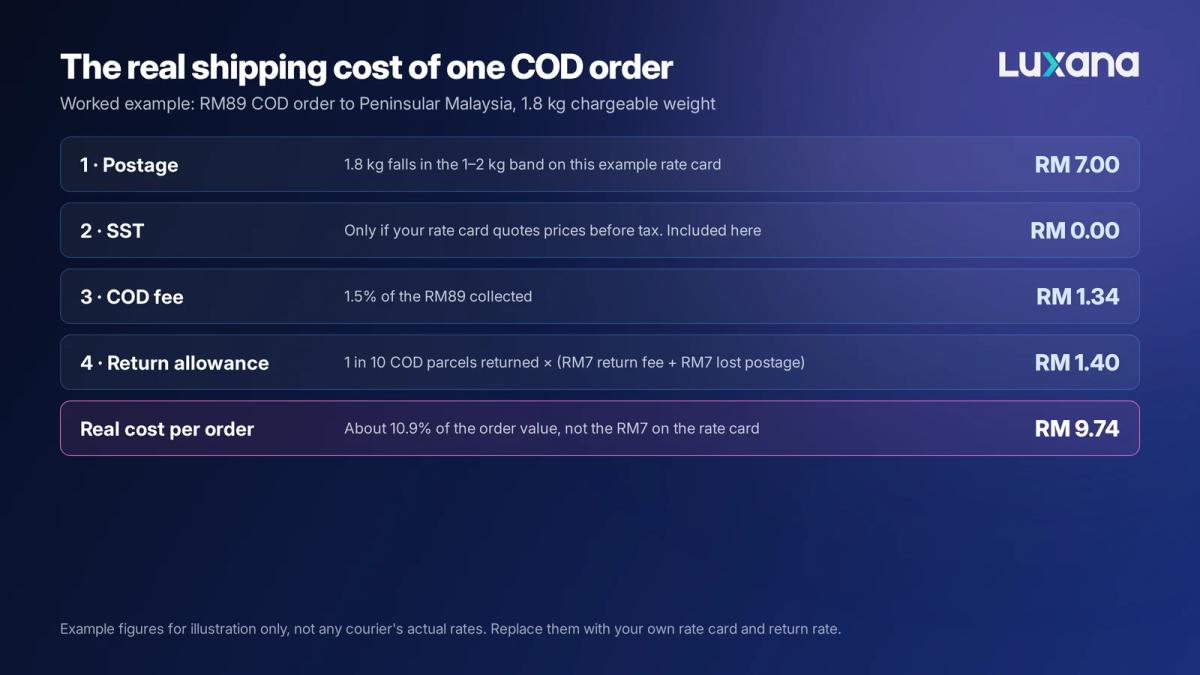
Here is the whole calculation for one order, using the example figures above. Swap in your own numbers to get your real cost.
| Item | Calculation | Example cost |
|---|---|---|
| Chargeable weight | Higher of 0.8 kg actual and 1.8 kg volumetric | 1.8 kg |
| Postage | 1.01 to 2 kg band, Peninsular Malaysia | RM 7.00 |
| SST | Included in this example rate card | RM 0.00 |
| COD fee | 1.5% of RM89 | RM 1.34 |
| Return allowance | 10% x (RM7 return fee + RM7 postage) | RM 1.40 |
| Real shipping cost | Total per order | RM 9.74 |
In this example, shipping is about 10.9% of the order value, not the 7.9% you would assume from the postage alone. Do this for your top products and your main zones, and you’ll know where your margin really goes. Our guide on how to calculate net profit for an online business shows where shipping fits alongside product cost, ads and platform fees.
How to set the shipping fee you charge customers
Knowing your real cost makes it much easier to decide what to charge. Common approaches for Malaysian online stores:
| Approach | How it works | Best for |
|---|---|---|
| Flat rate by zone | One fee for Peninsular Malaysia, a higher one for East Malaysia | Most stores with similar-sized products |
| Free shipping above a threshold | Free shipping once the cart passes a set amount | Raising average order value |
| Weight-based | Fee follows the chargeable weight bands | Stores with very mixed product sizes |
| Built into the price | Product price includes shipping, shown as free | Single-product or bundle offers |
7 ways to lower your shipping costs
- Right-size your boxes. Keep two or three box sizes that fit your best sellers snugly so volumetric weight doesn’t take over. A well-organised packing station makes this easy to stick to.
- Weigh every parcel. Guessing weights leads to under-declared parcels that get adjusted later, or over-declared ones you overpay for.
- Compare couriers per lane. The cheapest courier to Klang Valley is not always the cheapest to Sabah. See how to choose a courier for your online business.
- Route orders automatically. Rules that pick a courier by zone, weight or COD status stop staff from defaulting to one courier for everything.
- Cut COD returns. Confirm COD orders before shipping and send tracking updates so customers expect the parcel.
- Negotiate once you have volume. Monthly parcel counts and a clean return rate give you a stronger case for better rates.
- Review your invoices monthly. Compare what you were billed with what you expected, especially weight adjustments and return fees.
Track real shipping cost per order in your order system
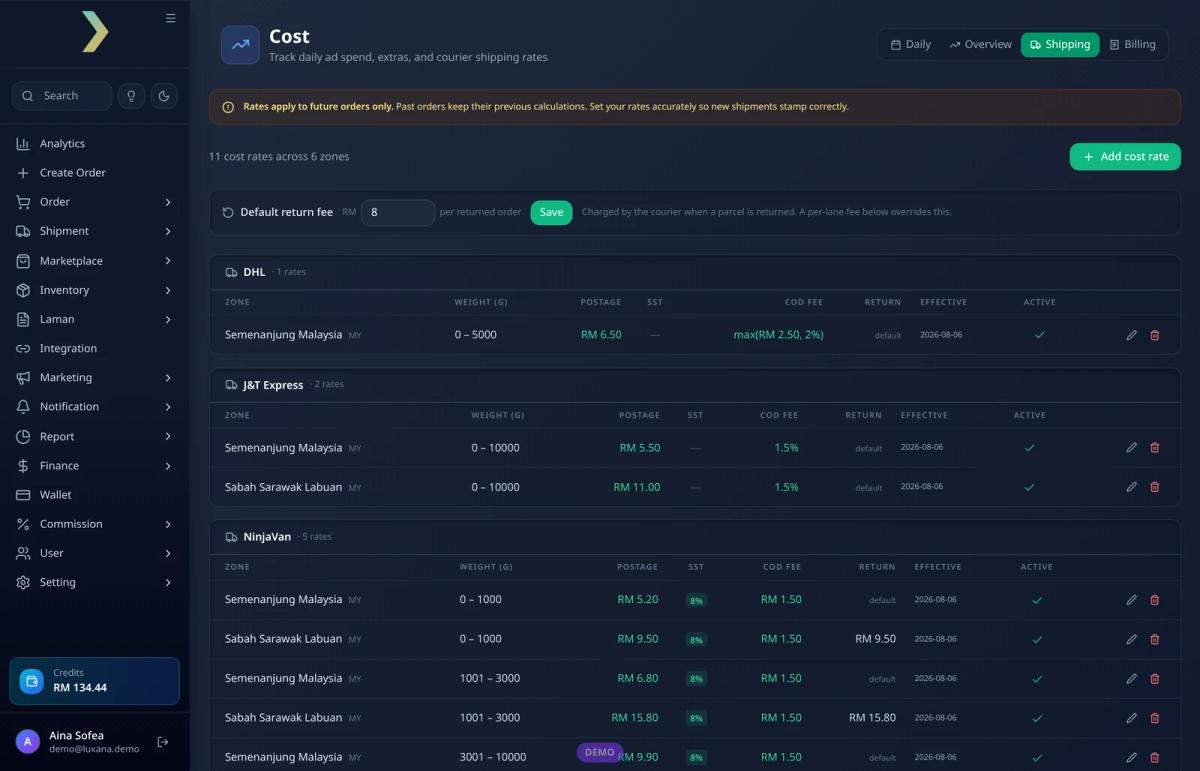
Doing this in a spreadsheet works for a handful of orders. Once you ship with several couriers to different zones, it is much easier when the rate card lives inside your order system and each shipment is costed automatically.
In Luxana, you add each courier’s rates by zone and weight band, together with SST, the COD fee (flat, percentage or a minimum) and the return fee. Every new shipment is stamped with its cost when it’s created. Rates apply to future orders only, so past orders keep the cost they were calculated with when you update a rate card. That shipping cost then flows into your net profit view next to product cost, COD cost and ad spend.
Frequently asked questions
What is volumetric weight?
Volumetric weight (also called dimensional weight) is a weight calculated from a parcel’s size. Couriers use it so large, light parcels pay for the space they take up. It is usually length x width x height in cm divided by a divisor such as 5,000 or 6,000.
Which divisor do couriers in Malaysia use, 5,000 or 6,000?
It depends on the courier and sometimes on the service or account type. Many rate cards use 5,000, but don’t assume: check your courier’s rate card or ask your account manager, because the divisor changes the result by about 20%.
Why is shipping to Sabah and Sarawak more expensive?
Parcels to East Malaysia travel further and usually move by air or sea, so most couriers price Sabah, Sarawak and Labuan as a separate, higher zone. If you sell there regularly, compare couriers specifically on that lane and consider a separate shipping fee for East Malaysia.
Should I include returns in my shipping cost?
Yes. Returns are a real shipping cost, especially for COD orders. Spreading the return cost across all orders as an allowance gives you a more honest cost per order and helps you set prices and free-shipping thresholds that still make money.
Know your real shipping cost before you set your prices
Shipping is one of the few costs that changes with every order, so it is worth getting right. Luxana is a Malaysian order management system (OMS) that brings orders from all your channels, courier rates and bookings, packing scans and returns, plus a CRM with official WhatsApp, into one system, so every order shows what it actually cost to ship. If you’d like to see your shipping cost and profit per order without the spreadsheet, see how Luxana works.
Read also: Cara Pilih Kurier untuk Bisnes Online: Panduan Multi-Kurier | Parcel Gagal Dihantar? Cara Selamatkan Order Sebelum Jadi Return | E-commerce Order Fulfillment in Malaysia: The Complete Guide | Cara Kira Untung Bersih Bisnes Online

Run orders, couriers and WhatsApp in one place
Built for Malaysian online sellers. Set up in an afternoon.


