How to Reduce Return Parcels in Malaysian E-commerce: Costs, Causes and a 7-Step Plan (2026)
A practical guide for Malaysian online sellers: the real cost of a return parcel, the common causes of RTS, and a 7-step plan to prevent returns before dispatch and rescue failed deliveries the same day.
- Published
- Updated
- Reading time
- 11 min read
- Language
- English

On this page 7 sections
- What a return parcel really costs you
- Failed delivery vs return parcel: know the difference
- Why parcels get returned in Malaysia
- 7 steps to reduce return parcels
- Step 1: Capture the full address and phone number correctly
- Step 2: Check the postcode and courier coverage
- Step 3: Confirm COD orders before you ship
- Step 4: Hold incomplete orders before printing the AWB
- Step 5: Pack the right item and check before handover
- Step 6: Act on the first failed attempt, the same day
- Step 7: Track your return numbers every week
- Signs your store has a return parcel problem
- Frequently asked questions
- Reduce returns from one system
A return parcel looks like one small failed order. In reality you paid to ship it out, you might pay again to get it back, your team spends time chasing it, and the sale you thought you had is gone. For Malaysian online sellers who ship a lot of COD orders, returns (often called RTS, return to sender) are one of the quietest leaks in the business.
The good news: most returns are not bad luck. They come from a handful of repeat causes, and you can stop them at two points: before the parcel leaves and right after the first failed delivery attempt. This guide covers what a return really costs, why parcels get returned in Malaysia, and a practical 7-step plan to reduce return parcels in your store.
What a return parcel really costs you
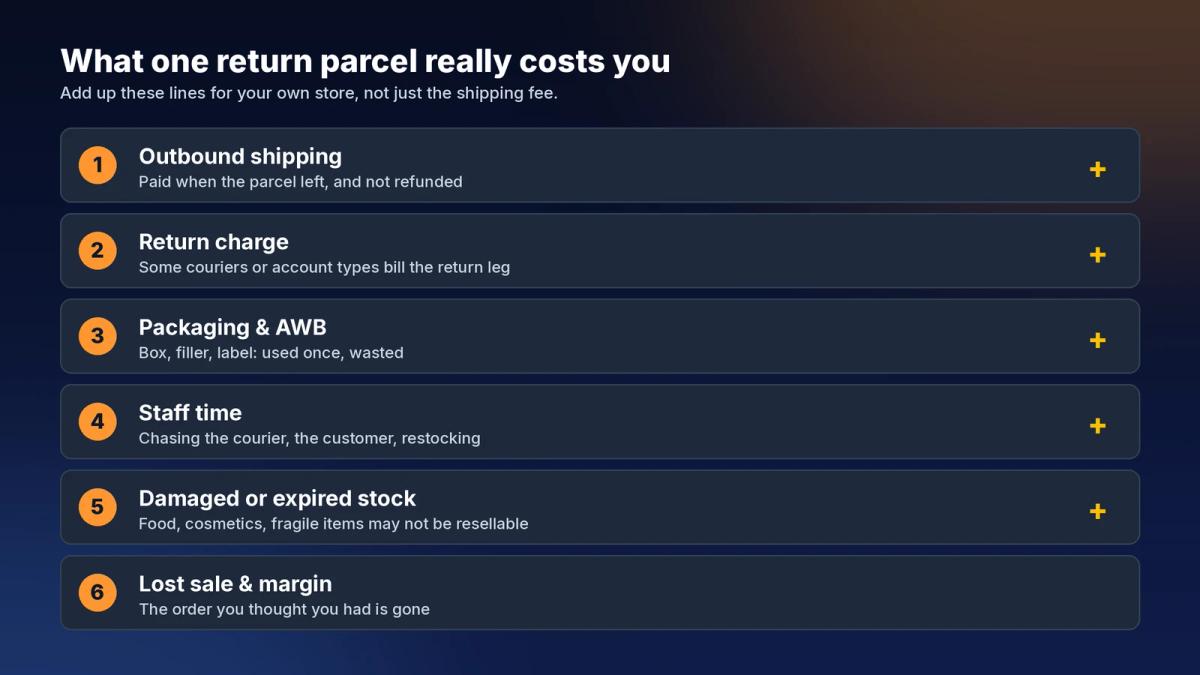
Most sellers think of a return as "one lost shipping fee". Add up every line and the cost is usually much bigger:
| Cost | What it means for you |
|---|---|
| Outbound shipping | You already paid to send the parcel. It is not refunded when the parcel comes back. |
| Return charge | Depending on your courier and account type, the return leg may be billed too. Check each courier's policy. |
| Packaging and AWB | The box, filler and label are used once and wasted. |
| Staff time | Checking tracking, calling the customer, chatting with the courier, receiving and restocking. |
| Damaged or expired stock | Food, cosmetics and fragile items may not be resellable after a round trip. |
| Lost sale and margin | The revenue you counted is gone, and COD cash never arrives. |
To see your own number, take one typical returned order and fill in each line with your real shipping rates and margins. Our guide on how to calculate shipping costs in Malaysia helps with the courier side, and how to calculate net profit (in Malay) shows how returns eat into your real margin.
Failed delivery vs return parcel: know the difference
These two terms are often mixed up, but the difference matters because it tells you when you can still act.
- Failed delivery: the courier tried to deliver but could not hand the parcel over. The parcel is usually still with the courier and can be re-delivered.
- Return parcel (RTS): the courier has stopped trying, or the customer refused the parcel, so it is on its way back to you.
The number of attempts and how long a parcel is held at the hub differ by courier and account type. That window between the first failed attempt and the return is your best chance to save the order. We cover the rescue steps in detail in Parcel Gagal Dihantar (in Malay).
Why parcels get returned in Malaysia
Returns usually come from the same few causes. Knowing which one you are dealing with tells you what to fix:
| Cause | Typical example | Where to fix it |
|---|---|---|
| Incomplete or wrong address | No house or unit number, wrong postcode, unclear taman name | Order capture and pre-dispatch checks |
| Customer can't be reached | Wrong phone number, phone off, ignores the courier's call | Order capture and same-day follow up |
| Nobody home | Parcel arrives during office hours | Follow up to agree a time or an alternative address |
| COD refused | Not enough cash, changed their mind, forgot they ordered | COD confirmation before shipping |
| Area hard to reach or outside coverage | Rural areas, gated communities, limited cold-chain coverage | Postcode and coverage check, courier choice |
| Wrong item or damaged parcel | Packed the wrong variant, poor packing | Packing station checks |
Notice that almost every cause can be spotted before the parcel leaves your warehouse. That's where the biggest savings are.
7 steps to reduce return parcels
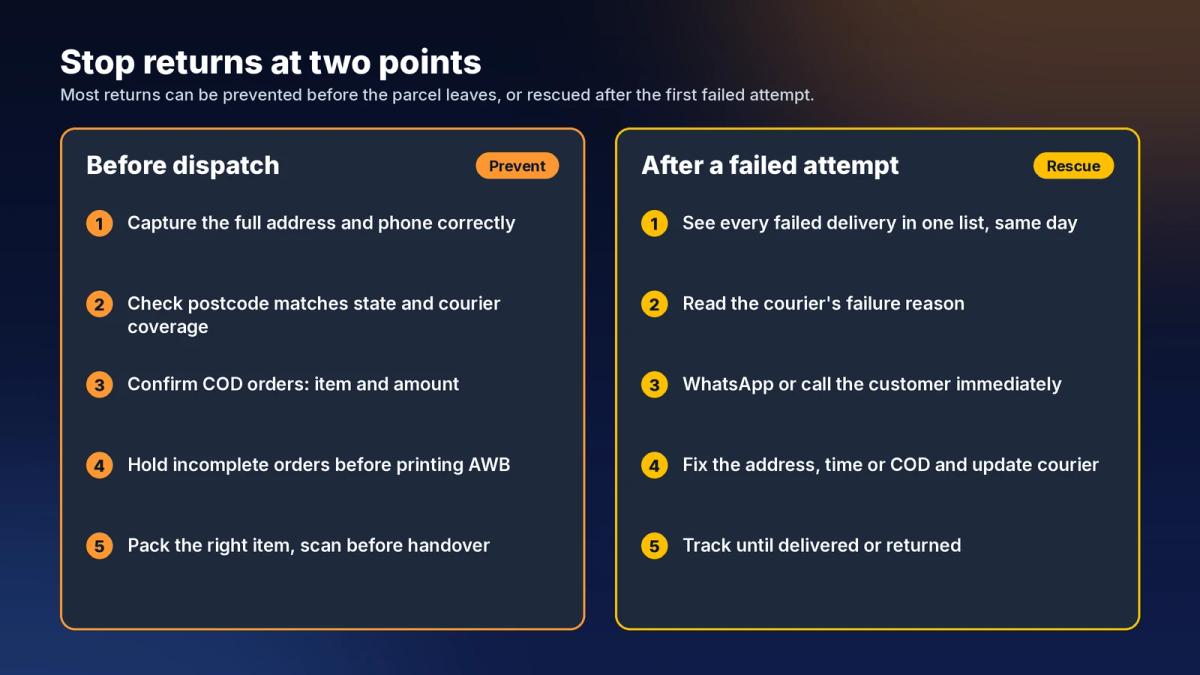
The return prevention plan
- Capture the full address and phone number correctly
- Check the postcode and courier coverage
- Confirm COD orders before you ship
- Hold incomplete orders before printing the AWB
- Pack the right item and check before handover
- Act on the first failed attempt, the same day
- Track your return numbers every week
Step 1: Capture the full address and phone number correctly
Many wrong addresses are not the customer's fault. They come from retyping orders from WhatsApp chats, forms or screenshots. Every manual copy is another chance for a missing unit number or a swapped digit in the phone number.
Ask for the address in a fixed format (house or unit number, street, taman, postcode, city, state) and avoid retyping wherever you can. If many of your orders come in through WhatsApp, AI Paste in Luxana helps turn a pasted chat into a structured order, so you are not typing addresses one by one.
Step 2: Check the postcode and courier coverage
A postcode that doesn't match the state is an early sign of a bad address. For frozen or chilled products you also need to know the address is inside your cold-chain courier's coverage before you accept the order.
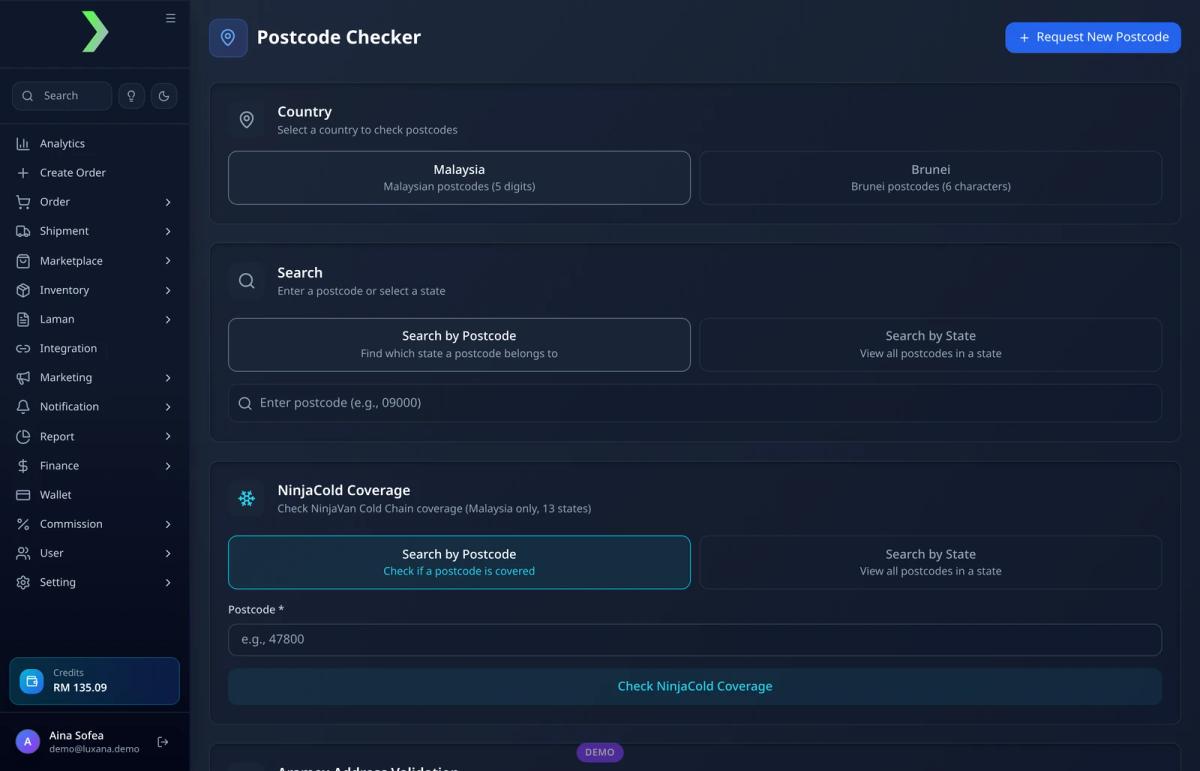
Luxana's Postcode Checker lets your team check the state for any postcode in Malaysia and Brunei, view all postcodes in a state, and check whether a postcode is covered by NinjaCold, Ninja Van's cold-chain service.
Step 3: Confirm COD orders before you ship
COD orders carry the highest return risk because the customer can simply refuse the parcel at the door. A short, polite confirmation message before shipping that states the product, the COD amount and the expected delivery window helps the customer get ready with cash and reminds them they actually ordered.
Example message:
"Hi Kak Aisyah, your order #10823 (Kopi Pracampur 3-in-1) is ready to ship. COD amount: RM49. Could you reply YES to confirm? We'll send your tracking number once it's out."
Send order updates through the official WhatsApp Business API with approved templates, not unofficial blasting tools that put your number at risk. See our WhatsApp order notification guide for which updates to send and when.
Step 4: Hold incomplete orders before printing the AWB
The cheapest time to fix a bad order is before the airway bill is printed. Once a label is on the box and the parcel is with the courier, every fix is slower and costlier.
In Luxana's Fast Ship page, order validation issues are listed before a batch is created, for example a bank transfer with no receipt or incomplete customer details, and invalid orders are skipped when you approve orders in bulk. New to AWBs? Read what an AWB is and how to print shipping labels in bulk.
Pre-dispatch checklist
- Full address with house or unit number, street, taman, postcode and state
- Postcode matches the state
- Phone number is complete and reachable
- Payment type and COD amount are correct
- Area is inside the courier's coverage, especially for frozen items
- Special notes (fragile, frozen, gift) are clear for the packer and courier
Step 5: Pack the right item and check before handover
A customer who receives the wrong variant or a damaged item is likely to refuse or return it. Use a consistent packing station, scan or check each item against the order, and do a final count before courier pickup. We go deeper in how to reduce wrong packing (in Malay) and how to set up a packing station.
Choosing the right courier for each area also matters. Automatic courier rules let you send orders to the most suitable courier by state, parcel weight, sales channel or postcode prefix. See how to choose a courier (in Malay).
Step 6: Act on the first failed attempt, the same day
The biggest problem is not the failed attempt itself. It is that nobody notices until the parcel is already on its way back. If your team has to open every courier portal and check tracking numbers one by one, failed deliveries slip through, especially when you use more than one courier.
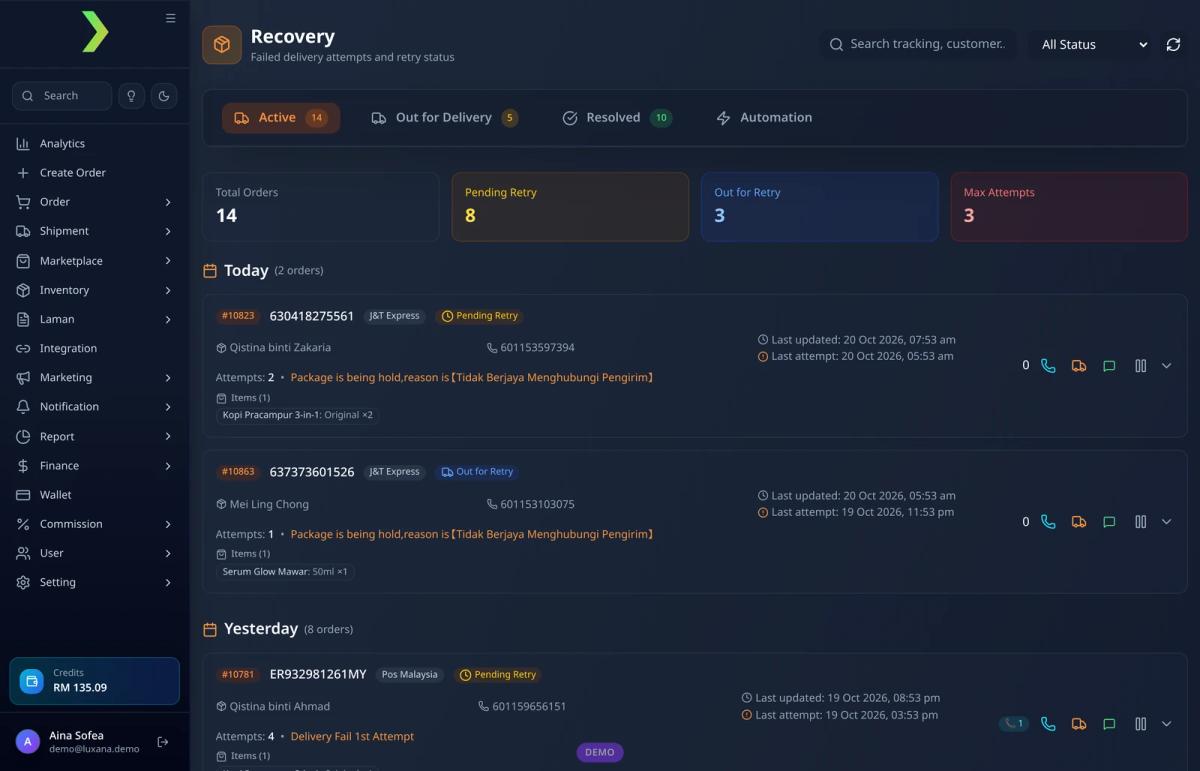
In Luxana, the Recovery page gathers every failed delivery in one place, grouped by day. You can see how many orders are Pending Retry, Out for Retry or have reached Max Attempts, along with each order's tracking number, courier, attempt count, last attempt time and the reason reported by the courier. From each order your team can call the customer, check tracking or send a WhatsApp message, because the CRM is built directly into the OMS and the customer's details are already there.
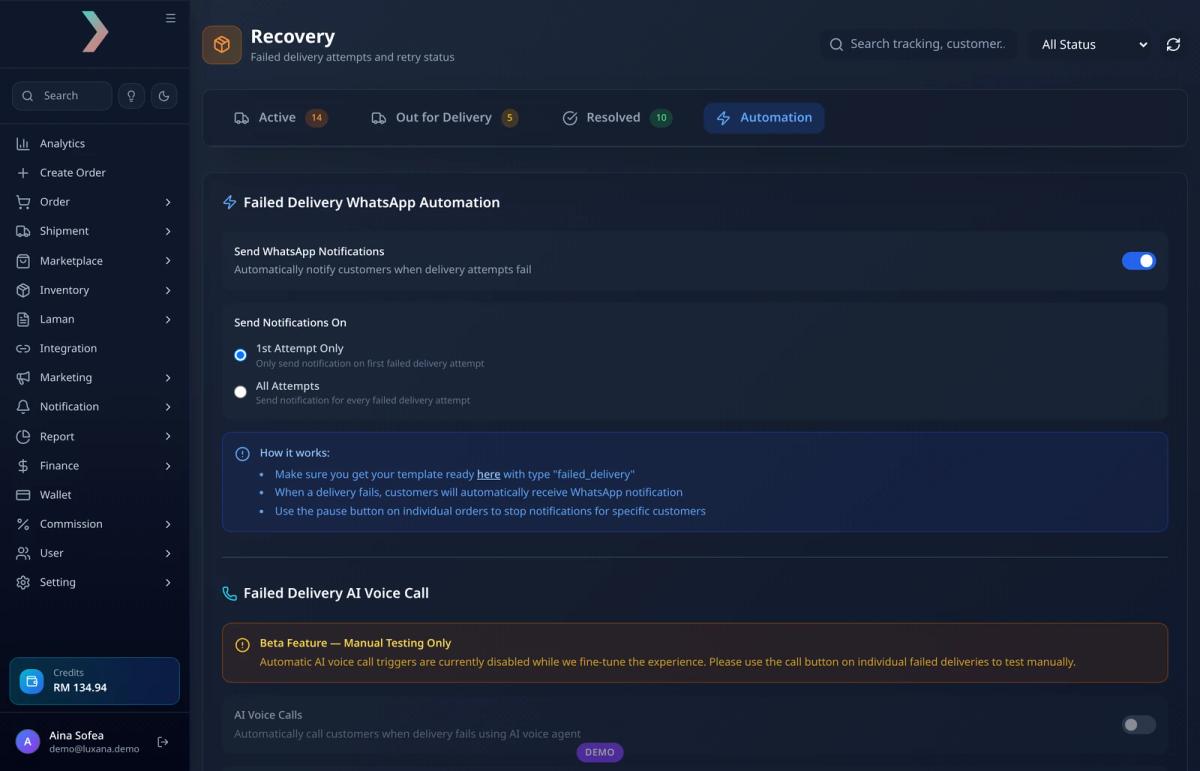
For higher volumes, the Automation tab in Recovery can send a WhatsApp notification automatically when a delivery fails, either on the first failed attempt only or on every failed attempt. It uses a failed_delivery WhatsApp template that you set up yourself, and you can pause notifications for a specific customer from their order.
Step 7: Track your return numbers every week
You don't need a complicated dashboard. Check these numbers weekly to see if your changes are working:
| Metric | How to calculate | What it tells you |
|---|---|---|
| Failed delivery rate | Parcels with a failed attempt ÷ parcels shipped | How often problems happen |
| Recovery rate | Failed parcels eventually delivered ÷ failed parcels | How well your follow up works |
| Return rate | Parcels returned ÷ parcels shipped | How much revenue and shipping you lose |
| Top failure reason | Count by courier reason | Which part of the process to fix first |
| Failure rate by courier | Failed attempts ÷ parcels, per courier | Which courier suits which area |
If the top reason is a wrong address or phone number, fix order capture (steps 1 and 2). If it is refused COD, focus on confirmation (step 3). If customers are returning the wrong item, look at packing (step 5).
Signs your store has a return parcel problem
You probably need a better process if:
- Customers often say they never knew the parcel was coming
- Courier return charges keep showing up on your invoices
- Staff spend hours each week fixing shipment issues
- You only find out about failed deliveries when the parcel is already back
- Fulfilment becomes chaotic during campaigns and sales
- Orders, tracking and customer chats sit in different places
Frequently asked questions
What is a return parcel?
A return parcel (often called RTS, return to sender) is a parcel the courier sends back to the seller after it could not be delivered, usually after the maximum number of attempts or because the customer refused it.
What is the difference between a failed delivery and a return?
A failed delivery means the courier tried and could not hand over the parcel, but it is usually still with the courier and can be re-delivered. A return means the courier has stopped trying and the parcel is on its way back to you.
Do I have to pay for return parcels in Malaysia?
It depends on your courier and account type. Some charge for the return leg and some don't, and you have already paid for the outbound shipment either way. Check each courier's policy for your account.
How do I reduce COD rejections?
Confirm COD orders before shipping, remind the customer of the product and amount, send tracking updates, and contact them the same day a delivery attempt fails.
Can I automate failed delivery messages?
Yes. Use the official WhatsApp Business API with an approved template. In Luxana, the Recovery page's Automation tab can send a WhatsApp message automatically on the first failed attempt or on every failed attempt.
Reduce returns from one system
Luxana is a Malaysian order management system (OMS) that brings orders, stock, couriers, AWBs, packing and an official WhatsApp CRM into one place, so you can catch bad orders before they ship and rescue failed deliveries before they become returns. If your team still checks parcel status one by one, try Luxana and see how many orders you can save.
Read also: Parcel Gagal Dihantar? Cara Selamatkan Order Sebelum Jadi Return | E-commerce Order Fulfillment in Malaysia: The Complete Guide | What Is an AWB? | Order Management System Malaysia
- return-parcel
- failed-delivery
- cod
- rts

Run orders, couriers and WhatsApp in one place
Built for Malaysian online sellers. Set up in an afternoon.


